Handing out free products is easy. Turning those products into customers is not.
That gap is where most product sampling campaigns succeed or fail. Brands that treat sampling as a giveaway measure boxes shipped and stop there. Brands that treat it as a conversion channel plan every stage, from who receives the product to what happens after they’ve tried it, and they can show the sales that follow.
This guide walks through how product sampling campaigns work in the UK, step by step, and what separates campaigns that convert from those that just cost money.
What product sampling campaigns are designed to achieve
A sampling campaign puts a product sample into the hands of a chosen audience so they can try it before they buy it. But trial is the middle of the journey, not the end.
A well-built campaign aims for three things:
- Trial: the right people use the product in a setting where they’ll actually notice it.
- Conversion: a clear, easy next step turns a good experience into a purchase, sign-up or download.
- Proof: data shows what the campaign delivered, so you can compare it against other channels and improve the next one.
When all three are planned together, product sampling campaigns can deliver conversion rates significantly higher than traditional display advertising. The reason is simple. A display ad asks someone to believe a claim. A sample lets them check it for themselves, so the purchase decision is based on experience rather than persuasion.
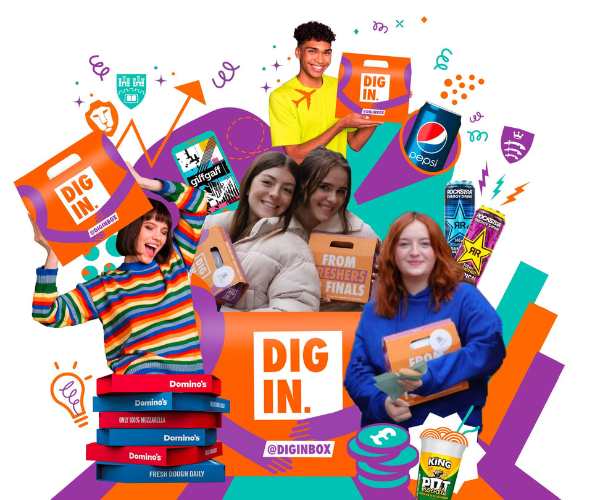
Step 1: Define the audience, moment and product fit
Strong product sampling campaigns all start with three questions.
Who needs to try this? Be specific. “18 to 24-year-olds” is a demographic. “First-year students setting up their own kitchen for the first time” is an audience with a need your product can meet.
When are they most open to something new? Timing is the most underrated factor in product sampling campaigns. People switch brands at moments of change: moving home, starting a job, beginning a new term. At those moments, old habits are broken and new ones haven’t formed yet. That’s why the start of the university year is one of the most valuable sampling windows in the UK. Students are choosing their supermarket, their bank, their phone network and their everyday brands, often for the first time.
Does trial actually help this product? Sampling works best when using a product is more convincing than describing it. Food, drink, personal care and beauty products are natural fits. Services work too, if the trial is easy. A SIM card or an app offer can be “sampled” as long as the first step takes seconds.
Get these three right and the rest of the campaign has something solid to build on. Get them wrong and no amount of logistics will fix it.
Step 2: Choose the right environment for trial
Where someone receives a sample shapes how they experience it. The same product can be forgotten in a busy high street or tried and talked about at home. It’s one of the biggest variables in product sampling campaigns, yet it’s often chosen last.
Common environments for product sampling campaigns include:
- Retail and point of sale: high purchase intent, but limited to people already shopping.
- Events and festivals: high energy and good for brand personality, but attention is split and products often get lost.
- Door-to-door and postal: private and uncluttered, but harder to target precisely.
- Student accommodation: samples arrive where students live, at the moment they move in, with little competing noise.
The best environment is one where the audience has time and reason to engage. That’s the logic behind welcome packs in student accommodation. The product arrives in a student’s room during their first days at university. It’s opened in a relaxed setting, often shared with new flatmates, and used straight away. Compare that with a flyer handed out on a crowded campus, and the difference in attention is obvious.
Environment also affects word-of-mouth. Products discovered in shared spaces get talked about, and among students, peer influence often matters more than any advert.
Step 3: Nail staffing, logistics and brand experience
Good strategy falls apart without good execution. This is the least glamorous part of product sampling campaigns and the part that most often goes wrong.
Logistics. Plan stock volumes, packaging, storage and delivery windows well in advance. Chilled or fragile products need extra care. Distribution needs to reach the right locations at the right time, not a week after the key moment has passed. At scale, this is where an established distribution network earns its keep.
Staffing. If your campaign involves people handing out samples, they are your brand for that moment. Brief them properly on the product, the key message and the next step you want recipients to take. Enthusiastic, well-informed staff lift conversion. Bored ones undo it.
Brand experience. The sample itself is a piece of marketing. Packaging should be clear about what the product is, why it’s worth trying and what to do next. A sample with no brand story or call to action is just a free item.
Compliance. Check age restrictions, allergen labelling and any sector rules before launch, including the advertising codes enforced by the Advertising Standards Authority. This matters especially for food, drink and financial products.
Step 4: Build in follow-up, redemption and measurement
This is where sampling becomes a conversion channel rather than a giveaway. The strongest product sampling campaigns decide in advance what happens after trial, and how to measure it.
Give people a reason to act now. Include a discount code, a first-purchase offer or a sign-up incentive with every sample. The goal is to turn a good first impression into a transaction while the experience is still fresh.
Make the next step effortless. QR codes that go straight to a relevant landing page work far better than a generic homepage link. Every extra click loses people.
Track redemption. Use unique codes or links per campaign, location or audience segment. This shows exactly which parts of the campaign drove sales.
Collect feedback while it’s fresh. Short, opt-in surveys can capture sentiment, brand recall and purchase intent within days of trial. Dig In’s Insight Engine collects this kind of data within 48–72 hours of activation, so brands can see what’s working while the campaign is still live.
Measure what matters commercially. Track cost per trial, cost per acquisition and repeat purchase rate. Compare these against your other channels. This is how sampling earns its budget.
The giffgaff campaign with Dig In shows the value of this approach to product sampling campaigns, with sign-ups tracked and grown year on year rather than treated as a one-off burst of activity.
Common reasons product sampling campaigns underperform
When sampling doesn’t deliver, the cause is usually one of these:
- Wrong audience. Samples go to people who were never likely to buy, so trial numbers look good but sales don’t follow.
- Wrong timing. The campaign misses the moment when people are open to change, and the product lands in an already settled routine.
- No clear next step. Recipients like the product but have no offer, code or link to act on, so the impulse fades.
- Distracting environment. Samples handed out in busy, noisy settings are pocketed and forgotten.
- Poor execution. Late deliveries, damaged stock or poorly briefed staff weaken the brand experience.
- Measuring volume, not value. Counting samples distributed says nothing about return. Without redemption and follow-up data, there’s no way to prove impact or improve.
Almost all of these come back to the same mistake: treating the sample as the goal instead of the first step towards a sale.
Plan product sampling campaigns that convert
Dig In runs product sampling campaigns that reach over 500,000 students each year across more than 160 UK universities. Products are delivered straight into student accommodation at the moment students are choosing the brands they’ll use for years. Every campaign is built around trial, conversion and measurable insight, from audience targeting and distribution through to feedback and redemption tracking.
Brands including Gillette and Venus, Nando’s and Boots have used Dig In’s product sampling campaigns to put their products in front of Gen Z.
Enquire about a sampling campaign and we’ll show you how to turn free trial into measurable sales.
Recent Posts
21 October 2026
How to Plan a Student Marketing Campaign That Actually Delivers
7 October 2026
Student Marketing Strategy: 5 Proven Steps to Win Gen Z (2026 Guide)

24 September 2026
What Is Product Sampling Marketing? Benefits, Formats and Examples

3 September 2026
Campus Marketing Statistics: UK Data, Trends and Benchmarks

27 August 2026
Student Engagement Statistics
