Most student marketing campaigns don’t fail because of a bad idea. They fail because of a rushed plan. The channel gets chosen before the objective is clear, the timing is set by internal deadlines rather than the student calendar, and nobody agrees on what success looks like until the campaign is over.
Campaigns with clear objectives and defined KPIs perform significantly better than reactive ones. The good news is that planning well isn’t complicated. It just needs to happen in the right order.
This guide walks through how to plan a student marketing campaign from brief to launch. It covers objectives, audience and timing, channel mix, logistics, KPIs and budgeting, and ends with a checklist you can use before any student marketing campaign goes live.
Table of Contents
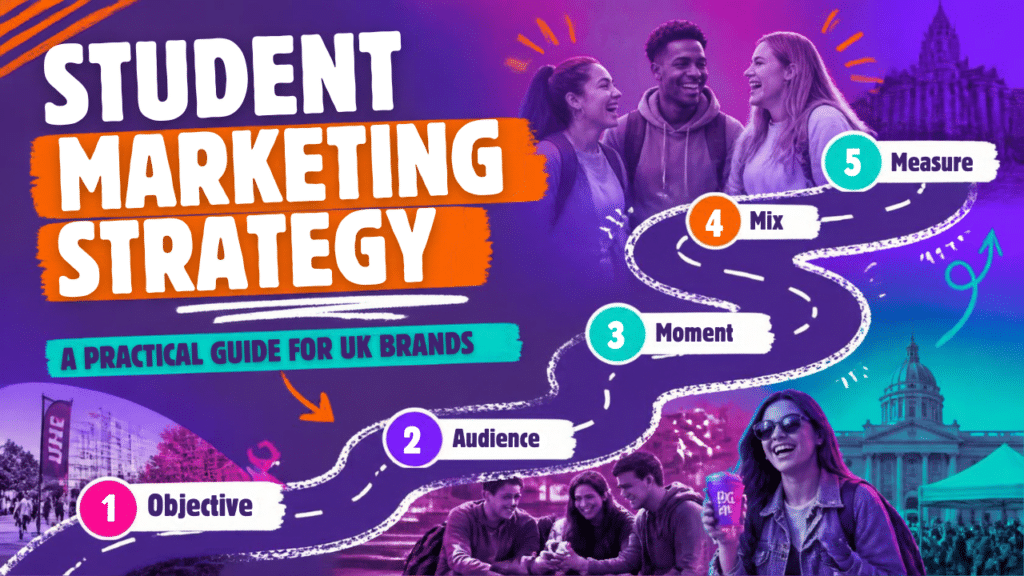
Start with the campaign objective, not the channel
The most common planning mistake is starting with a tactic. “Let’s do a Freshers’ fair stand” or “let’s get some student influencers” are answers. They only make sense once you know the question.
Start by writing down the single business outcome the campaign needs to deliver. Most student marketing campaigns fall into one of these:
- Awareness: make students in a target segment recognise and remember your brand.
- Trial: get your product into students’ hands so they can experience it.
- Acquisition: drive sign-ups for an account, app, SIM or subscription.
- Sales: increase purchases in store or online over a set period.
- Loyalty: turn existing student customers into repeat buyers and advocates.
Pick one primary objective. A campaign can support more than one goal, but when everything is a priority, nothing is. Then turn the objective into a measurable target with a deadline. “Increase awareness” becomes “reach 40,000 first-year students and lift unprompted recall by 10 points by the end of October.”
Finally, write a short brief that everyone signs off before any creative or media work starts. It should cover the objective, target, audience, timing, budget, key message and how results will be measured. A one-page brief saves weeks of rework later.
Define the student audience and the right moment to reach them
“Students” covers more than two million people with very different lives. A first-year in halls, a commuting postgraduate and a final-year student job hunting are three different audiences.
Narrow your audience using the factors that actually affect buying behaviour:
- Year of study and how settled their routines are
- Living situation, such as halls, private housing or living at home
- Location, from large city campuses to smaller university towns
- Interests and communities, such as sport, societies or course subject
- Home or international, since international students often arrive with no UK brand preferences at all
Then choose the moment. Students are most open to new brands at points of change. The biggest of these is move-in, when they are choosing a supermarket, bank, phone network and everyday essentials, often for the first time. Reaching students as they arrive means your brand is part of their routine before habits form.
Other strong moments include loan payment dates, the January restart, spring house hunting and exam season. Match the moment to your objective. Trial campaigns suit September; re-engagement campaigns often suit January.
Lock your timing early. University term dates vary, accommodation access windows are short and the best September slots fill up months in advance.
Build the campaign mix: sampling, ambassadors, experiential and digital

With the objective, audience and moment fixed, you can choose channels. Each one has a specific job, and the strongest campaigns combine several.
Sampling. Puts your product in students’ hands so they can try it rather than read about it. Best for trial and conversion, especially for food, drink, personal care and everyday products. Welcome packs delivered to student accommodation are one of the most effective formats, because students receive them in their own room, in a setting with little competing noise.
Student ambassadors. Real students who represent your brand on campus and on their own social channels. Best for credibility and word of mouth. Among students, peer influence often carries more weight than any advert.
Experiential. Pop-ups, events and campus activations that create memorable brand moments. Best for brand personality and social content, though reach per pound is usually lower than sampling.
Digital. Social media, creator content, paid search and email. Best for reach, retargeting and turning interest into action.
Connect the channels so each supports the next. A typical sequence is sample first, then capture interest through a QR code, then follow up with retargeting and a time-limited offer. The physical experience gives the digital activity something real to build on.
Budgeting the mix
There’s no fixed formula, but a simple way to split budget is by job:
| Job | Typical channels | Budget guide |
|---|---|---|
| Put the product in hands | Sampling, welcome packs | Largest share for trial and acquisition campaigns |
| Build credibility | Ambassadors, creators | Smaller, sustained spend across the term |
| Create moments | Experiential, events | Selective, tied to key dates |
| Convert and retarget | Paid social, search, email | Enough to follow up everyone reached physically |
Always hold back a contingency of around 10% for reprints, extra stock or a channel that outperforms and deserves more budget.
Plan logistics, permissions and staffing early
This is where good student marketing campaigns quietly go wrong. Build these into your timeline from the start, not in the final fortnight.
Permissions. Campus activity usually needs approval from the university, students’ union or accommodation provider. Some sites restrict certain categories, such as alcohol, gambling or high-sugar products. Check rules early and allow time for sign-off.
Stock and packaging. Confirm quantities, packaging, labelling and storage. Chilled, fragile or age-restricted products need extra planning. Build in a buffer for damaged or lost stock.
Distribution. Work back from your delivery date. Accommodation access windows around move-in are tight, and samples that arrive a week late miss the moment entirely. An established distribution network removes much of this risk at scale.
Staffing. If people are handing out product or running activations, brief them properly on the product, the key message and the next step you want students to take. Well-informed staff lifts conversion.
Compliance and data. Check allergen labelling, age restrictions and any sector rules, particularly for financial products. If you’re collecting student data, make sure it’s opt-in and GDPR-compliant.
Set KPIs that reflect awareness, engagement and conversion
KPIs should follow the student journey, from first seeing your brand to buying it. Set a target for each stage before launch, and make sure you can actually track it.
| Stage | Example KPIs | How to track |
|---|---|---|
| Awareness | Reach, brand recall, consideration | Distribution data, before-and-after surveys |
| Engagement | QR scans, survey responses, social interactions | Unique QR codes, campaign landing pages |
| Conversion | Sign-ups, code redemptions, sales | Unique discount codes, tracked links |
| Value | Cost per acquisition, repeat purchase, ROI | CRM and sales data over the following months |
A few principles make KPIs useful rather than decorative:
- Match KPIs to the objective. An awareness campaign shouldn’t be judged on day-one sales.
- Use unique codes and links for each channel or location, so you can see what worked.
- Collect student feedback quickly. Dig In’s Insight Engine captures sentiment, brand recall and purchase intent within 48 to 72 hours of activation, so you can adjust while the campaign is still live.
- Report on value, not volume. Samples distributed is an output. Cost per acquisition is a result.
A student marketing campaign checklist to use before launch
Use this checklist before any student marketing campaign goes live. If you can’t tick an item, fix it before launch rather than after.
Objective and brief
- One primary objective agreed and written down
- Measurable target with a deadline
- One-page brief signed off by all stakeholders
- Budget confirmed, including a contingency
Audience and timing
- Target student segment clearly defined
- Campaign timed to a key student moment
- Term dates and move-in windows confirmed for every target university
- Message tested with, or checked by, students in the target segment
Campaign mix
- Each channel has a clear job in the journey
- Physical and digital channels are connected
- Every touchpoint has a clear next step for students
- Offer or incentive in place to drive action
Logistics and permissions
- University, union or accommodation approvals received
- Stock, packaging and labelling confirmed, with a buffer
- Delivery schedule works back from the key moment
- Staff and ambassadors briefed on product, message and call to action
- Compliance, age restrictions and data consent checked
Measurement
- KPIs set for awareness, engagement and conversion
- Unique QR codes, links and discount codes set up per channel
- Baseline data captured before launch
- Feedback survey ready to go live with the campaign
- Reporting dates and owners agreed
A student marketing campaign that passes this checklist has a clear purpose, reaches the right students at the right time and can prove what it delivered. That’s the difference between a campaign that looks busy and one that actually delivers.
Plan your next student marketing campaign with Dig In
Dig In plans and delivers student marketing campaigns that reach over 500,000 students each year across more than 160 UK universities. We handle audience targeting, distribution into student accommodation, sampling and welcome packs, and real-time student insight, all built around the moments that shape student buying habits. Brands including giffgaff, Boots and Liquid I.V. have used Dig In to reach students at scale.
Book a campaign planning call and we’ll help you turn your objective into a student marketing campaign plan, from brief to launch.
Recent Posts
7 October 2026
Student Marketing Strategy: 5 Proven Steps to Win Gen Z (2026 Guide)

1 October 2026
How Product Sampling Campaigns Work and What Makes Them Convert

24 September 2026
What Is Product Sampling Marketing? Benefits, Formats and Examples

3 September 2026
Campus Marketing Statistics: UK Data, Trends and Benchmarks

27 August 2026
Student Engagement Statistics
