Gen Z and students
5 min read
Understanding Gen Z Lifetime Customer Value: Why It Starts at University
Why Gen Z lifetime customer value starts at university, which categories gain most from early acquisition and how to measure it from first trial onwards.
Gen Z lifetime customer value is the total margin a young customer brings over all the years they stay with a brand. For many categories the clock starts at university, because that is when students choose their own bank, mobile network, razor, skincare and weekly shop for the first time. A customer won at 18 or 19 gives a brand the longest possible runway.
This guide explains how to think about the lifetime value of a student customer, which categories gain most from early acquisition and how to measure progress before the long-term numbers are in.
Key points
Lifetime value is margin per year multiplied by years retained, minus the cost of acquiring the customer. Starting at university maximises the years.
Categories with long tenure and real switching effort, such as banking, mobile, personal care and everyday food and drink, gain most.
The first brand a student chooses independently often becomes the default. Be there when that choice is made.
Measure early signals at the time (trial, intent, registrations) and retention later, by tracking the cohort you acquired.
What lifetime customer value means for Gen Z
Lifetime value, often shortened to LTV or CLV, adds up what a customer is worth across the whole relationship. In its simplest form it has four parts:
Margin per year. What the customer is worth to you annually, after the cost of serving them.
Years retained. How long they stay before switching or lapsing.
Acquisition cost. What you spent to win them in the first place.
Referral value. Customers who bring others in, which matters a great deal in shared student households.
For Gen Z the shape of that curve is distinctive. Margin per year often starts low, because student budgets are tight, and rises as graduates move into work. The value sits in the years retained, which is why the point of acquisition matters so much.
Why university is the starting point
First independent choices
Before university, many brand choices are made by parents. On arrival, students set up their own accounts, sign their own contracts and do their own shopping, often for the first time. Our guide to the science behind product sampling success explains why life changes like this make habits unusually open.
Inertia works for the incumbent
Once a bank account is set up, a SIM is in the phone or a razor handle is in the bathroom, switching takes effort. The brand chosen in the first weeks benefits from that inertia for years, provided it does not give students a reason to leave.
The runway is longer
A customer acquired at 18 has more potential years ahead than one acquired at 30. Even modest retention rates compound over a long horizon.
Categories where early acquisition pays most
Finance and mobile
Banks and mobile networks have the clearest case: long tenure, real switching effort and income that grows after graduation. Santander’s 2025 partnership with Dig In combined physical reach with a direct response route; a 2025 Santander student mailer produced 1,053 registrations from 4,037 views. See the Santander 2025 results and our page on finance and mobile student marketing.
Personal care
Grooming and skincare routines formed at university can last for decades. After Freshers 2024 sampling, 87.6% of students surveyed said they were likely to buy Nivea Soft again and 98% said they would recommend it (n=2,986). See the Nivea Soft results.
Everyday food and drink
Weekly shop staples are bought often and repeatedly. Individual purchases are small, but frequency over many years adds up, and the first independent weekly shop is a moment of real choice.
How to estimate the lifetime value of a student customer
Map margin by life stage. Estimate what a customer is worth as a student, as a graduate and as an established professional. Use your own data where you have it.
Estimate retention from your own cohorts. Look at customers you acquired aged 18 to 22 in previous years and see how many are still active after one, three and five years.
Calculate acquisition cost per retained customer. Divide campaign cost by the number of customers still active at a sensible checkpoint, not by the number reached.
Add referral value. Students share kitchens, bathrooms and recommendations. Ask new customers how they heard about you.
Discount future value. Money in ten years is worth less than money today. Apply your usual discount rate so student acquisition is compared fairly with other spend.
Early signals you can measure now
Lifetime value takes years to prove, so brands need leading indicators they can read within weeks:
Trial. How many students received and used the product.
Purchase intent and advocacy. Survey students after trial and compare with a norm. Across Dig In’s brand surveys, the median brand scored 85% likely to buy again in 2025 (24 surveys) and 88% in 2026, and 96% would recommend (2025, 20 surveys).
Registrations and redemptions. Sign-ups, account openings or codes used, tagged so you know they came from the student campaign.
Opt-ins. Students who agree to hear from you again give you a route to retain them.
Treat these as signals, not proof. Purchase intent measures how students feel after trying a product; it is not a retention rate or a sales figure.
Keeping the customer after the first year
Follow up through the first year. Live Activations in the weeks after arrival, Refreshers in January and email to opted-in students keep the brand present while the habit forms.
Plan the graduation handover. Student pricing and student accounts end. Make the move to a graduate product or standard pricing easy and well signposted.
Track the cohort. Tag customers acquired through student campaigns so you can check their retention at 6, 12 and 24 months.
Questions brands ask
What is the lifetime value of a Gen Z customer?
It depends on the category: margin per year, multiplied by years retained, minus acquisition cost. Acquiring Gen Z customers at university maximises the years retained, which is where most of the value sits.
Is it worth marketing to students if they do not have much money?
For categories with long tenure, yes. The case rests on how many years a student stays with you, not on what they spend this term, and many first independent brand choices are made at university.
How do you measure whether student marketing builds long-term customers?
Tag the customers a student campaign acquires, using codes, sign-up sources or account flags, and track their retention over one to three years. Use trial, purchase intent and registrations as early signals in the meantime.
Working with Dig In
Dig In reaches 500,000 students each September, at the point they make their first independent brand choices, and follows up through the year. Get in touch to plan a student campaign built around long-term customers.
Read next

Gen Z and students
The Student Effect: Household Influence, Word of Mouth and Physical Marketing in the Age of AI
How returning students shape what their families buy and what their friends try, and an honest look at whether physical marketing such as sampling still earns its place as AI changes advertising.
9 min read

Gen Z and students
Student Cost of Living in the UK: What Students Spend, What They Get and What It Means for Brands
What UK students spend each month, including food, against what the Maintenance Loan covers, and how the gap shapes what students buy and try.
8 min read
Gen Z and students
UK Student Population Statistics: How Many University Students Are There in the UK?
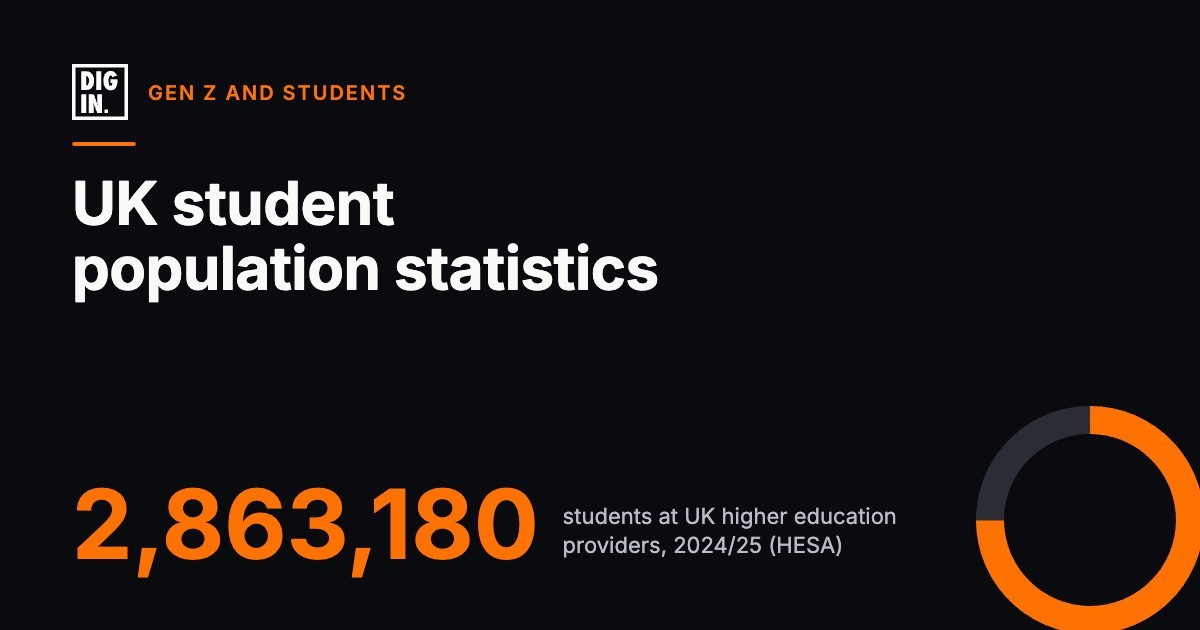
The latest HESA and UCAS figures on the UK student population: total enrolments, first-year intake, entry rates and the rise in students living at home.
8 min read