Gen Z and students
5 min read
Marketing to Gen Z University Students: A Guide for Brands
A brand guide to marketing to Gen Z university students: what they value, how the 4 Ps apply to them and a five-step plan from brief to measured results.
Marketing to Gen Z university students works when it starts from their situation: young adults living away from home, managing their own money and choosing everyday brands for the first time. Win them with products that are useful and fairly priced, reach them where they live and at the moments they make new choices, and ask them what they think. This guide sets out what students value, how the 4 Ps apply to them and a five-step plan to follow.
Key points
University students are Gen Z at a specific life stage: newly independent, budget-conscious and open to new brands.
Money matters most. only 30% feel confident managing money (Student Futures Index 2026, Dig In with We Are Futures, 1,086 students).
Reach them in the places and moments that shape habits: halls of residence, Freshers in September and the return in January.
Ask students directly. Survey data tells you what they think of your product, not what a trend report says Gen Z thinks in general.
Gen Z versus university students: why the distinction matters
Gen Z covers a wide age range, from school pupils to people in their late twenties with careers and mortgages. University students are a narrower group with one thing in common: for most first-years, this is the first time they have shopped for themselves. Generic Gen Z advice about values and platforms is useful background, but the student life stage is what creates the opportunity. Habits that form in the first term can last well beyond graduation.
What Gen Z students value
Value for money
The Student Futures Index 2026, from Dig In with We Are Futures, found 88% of students say managing money is an important life skill and only 30% feel confident managing money. Price, pack size and offers matter more to students than to most audiences.
Products that fit how they live
Students live in small rooms and shared kitchens, often cook for one and study late. Products that suit that life (quick, compact, easy to store) earn a place.
Honesty about health and values
Students read labels and check claims. In Coca-Cola’s 2026 surveys with Dig In, 51.0% of students said they prefer zero or reduced sugar drinks (n=3,393). If your brand makes a claim on health or sustainability, give the specifics.
Being asked
Students respond to brands that ask for their views and act on them. A short survey after trial is a simple way to show you are listening.
The 4 Ps for a student audience
Product: lead with the item in your range that solves an everyday student problem, not necessarily your newest launch.
Price: make value visible. A student price, a code or a pack size suited to one person or a shared house all help.
Place: be stocked near campus and present where students are. Physically, that means halls of residence; online, the platforms they use daily and the discount sites they search.
Promotion: combine reach with direct contact. Social media builds familiarity; sampling and email put the offer in students’ hands.
A five-step plan for marketing to students
Set one objective. Trial, awareness, registrations or sales. Each needs a different mix, so decide first.
Choose the moment. Freshers in September is the biggest window; January Refreshers is the second. Exams and housing moves add smaller ones.
Pick the channels. For trial, sampling in halls through the Welcome Bag or Live Activations. For reach, social and creators. For response, email and student discount platforms. Our guide to advertising to university students covers each in detail.
Make the next step easy. Tell students where to buy and give them a reason to act soon.
Measure and repeat. Survey students after trial, track redemptions and repeat purchase, and plan the next intake.
Measuring what students think
Student marketing is easy to count by reach and hard to judge by outcome. Surveys close that gap. Dig In’s survey programme has collected over a million survey responses since 2016, and its Trial Benchmark pools 196 brand surveys for 161 brands since 2018. In 2025 the median brand scored 85% likely to buy again (24 surveys) and 96% would recommend (20 surveys); in 2026 the median for likely to buy again was 88%.
Named results show what strong looks like. In 2026, 89.9% of students surveyed were likely to buy Coca-Cola Original and Zero (n=3,019). Hershey’s and Reese’s scored 89.7% likely to buy again (Freshers 2024, n=3,381). These are measures of purchase intent after trial, not of sales, and they work best alongside your own sales data. Dig In’s wider student research is on our research page.
Turning first purchases into loyalty
A first trial is only the start. Students switch readily, so loyalty comes from showing up again at the moments they restock, with value they can see. Our guide to building brand loyalty among students sets out a year-round plan.
Questions brands ask
How do you market to Gen Z university students?
Start from their life stage: newly independent and budget-conscious. Offer useful, fairly priced products, reach them in halls and at Freshers and Refreshers, and survey them after trial to see what worked.
What do Gen Z students care about most when choosing brands?
Value for money comes first: only 30% feel confident managing money (Student Futures Index 2026, Dig In with We Are Futures, 1,086 students). After price, they look for products that fit student life and brands that are straight about their claims.
Is marketing to university students different from marketing to Gen Z in general?
Yes. University students share a life stage, buying for themselves for the first time, which makes them more open to new brands than Gen Z as a whole. That makes timing around the academic year more important than platform choice.
Working with Dig In
Dig In has worked with brands targeting students since 2015, reaching 500,000 students each September through its Welcome Bag and Live Activations and surveying them on what they thought. To plan a student campaign, get in touch.
Read next

Gen Z and students
The Student Effect: Household Influence, Word of Mouth and Physical Marketing in the Age of AI
How returning students shape what their families buy and what their friends try, and an honest look at whether physical marketing such as sampling still earns its place as AI changes advertising.
9 min read

Gen Z and students
Student Cost of Living in the UK: What Students Spend, What They Get and What It Means for Brands
What UK students spend each month, including food, against what the Maintenance Loan covers, and how the gap shapes what students buy and try.
8 min read
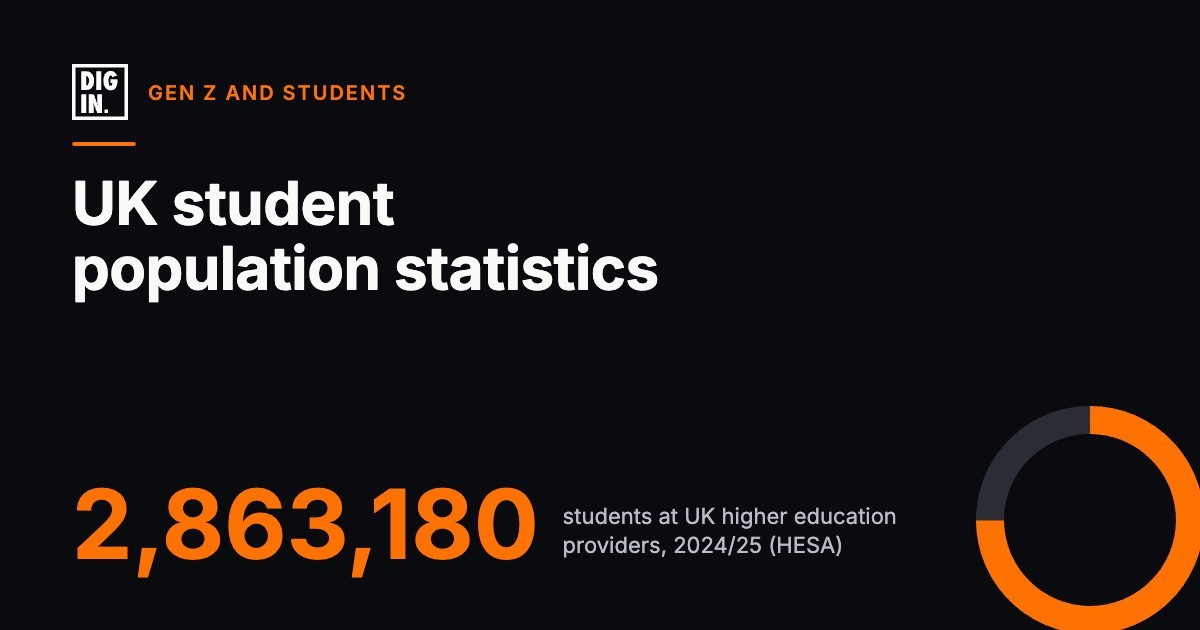
Gen Z and students
UK Student Population Statistics: How Many University Students Are There in the UK?
The latest HESA and UCAS figures on the UK student population: total enrolments, first-year intake, entry rates and the rise in students living at home.
8 min read