Gen Z and students
5 min read
Gen Z Spending Habits in the UK: The Value-Driven Student Shopper
How UK students fund and plan their spending, what value means to a shopper on a fixed budget, and what that means for pricing, packs and sampling.
UK students spend carefully. Most are managing a fixed termly budget for the first time, so they look for value: products that are worth the money, from brands they can trust, at a price they can justify. Values such as sustainability matter, but they sit alongside price, and the chance to try before buying carries real weight.
This guide looks at how students fund their spending, what value means to them and what that means for how brands price, pack, time and introduce their products.
Key points
Money is front of mind. In the Student Futures Index 2026 by Dig In with We Are Futures (n=1,086), only 30% of students said they felt confident managing money.
Students want to get money right: 88% in the same study said managing money is an important life skill.
Value means worth it, not cheapest. Quality, size and usefulness count alongside price.
Trial lowers the risk of spending on something new, which is why sampling suits budget-conscious shoppers.
Timing matters. Student budgets arrive in lumps at the start of term and run thin by the end.
How UK students fund their spending
Most full-time undergraduates in the UK rely on a mix of three sources: a maintenance loan, part-time work and help from family. Maintenance loans are paid in instalments, usually at the start of each term, which gives student spending a distinctive rhythm. Money arrives in a lump, the first weeks feel comfortable and the final weeks of term are tight.
For first-years, this is often the first time they have managed rent, food and everything else from one pot of money. Many are learning to budget in real time, which makes them cautious about unfamiliar products and loyal to ones that prove themselves.
What value means to a student shopper
Worth the money
Students compare price with how long something lasts and how often they will use it. A larger pack that lasts the term can feel better value than a cheaper one that runs out in a week.
Low risk
On a tight budget, a disappointing purchase hurts. Familiar brands and products they have already tried feel safer, which is why a first trial matters so much.
Useful in student life
Shared kitchens, small fridges and limited cupboard space shape what is practical. Products that suit halls, such as single portions, compact packs and things that need little equipment, have an advantage.
Values that tip the choice
Ethics and sustainability matter to many students. On a fixed budget, they tend to work best as a reason to choose between products at a similar price. Our guide to understanding Gen Z values looks at this in more detail.
Where and how students shop
The weekly shop. Supermarkets and discounters near campus or halls, often in a group, and increasingly online for heavier items.
Convenience on the go. Campus shops, meal deals and quick food between lectures.
Student discounts. Many students check for a student price before buying, through student discount platforms or by asking in store.
Social discovery. Students often first see new products on TikTok or Instagram, then check price and reviews before buying.
Recommendations from flatmates. In shared living, a good find gets passed around quickly.
What this means for brands
Make the first try free
The biggest barrier for a budget-conscious student is the risk of wasting money on something new. A sample removes it. Once a student has tried a product and liked it, paying for it next time is a much easier decision. Our product sampling page explains how this works at scale.
Get the pack and price right
Check that the product students try is available in a size and at a price that suits them, in the shops near campus. A great sample followed by a pack that only comes in a family size, at a big supermarket across town, wastes the trial.
Use offers with a purpose
Discounts get attention, but a code with no follow-up rarely builds a habit. Tie the offer to the first trial, make it easy to redeem near campus and track redemptions so you know which students acted.
Time it to the budget cycle
The start of term is when students have money and are setting routines. September is the biggest moment, and January is a second chance: students return from the holidays, budgets reset and many are open to changing what they buy. See our page on Refreshers for how brands use January.
Show value plainly
Tell students what the product costs per portion or per use, what it replaces and why it is worth it. Clear, checkable claims carry more weight than broad promises with a budget-minded audience.
How to tell whether you won on value
Ask about value directly. Survey students after trial: was it good value, would they pay full price, where would they buy it?
Compare against a norm. Across Dig In’s brand surveys, the median brand scored 85% likely to buy again in 2025 (24 surveys) and 88% in 2026, and 96% would recommend (2025, 20 surveys).
Watch redemptions. Codes used near campus show whether intent turns into action.
Purchase intent measures how students feel about a product they have just tried. It is a useful signal, not a sales figure. Our research page explains how Dig In runs its student surveys.
Questions brands ask
How do UK students spend their money?
Most students fund their spending through a maintenance loan paid at the start of each term, part-time work and family support. Food, rent and essentials come first, and they shop around for value, often using student discounts.
Are Gen Z students more loyal to cheap brands or ethical brands?
They are loyal to brands that prove worth the money. Ethics and sustainability help a brand win a close choice, but on a fixed budget, price, quality and usefulness usually decide.
What is the best way to market to students on a budget?
Let them try the product for free, make sure it is available near campus in a size and at a price they can afford, and time your activity to the start of term when budgets reset.
Working with Dig In
Dig In puts products into the hands of 500,000 students each September, so they can try before they spend, and follows up in January. Get in touch to plan a campaign around the student budget cycle.
Read next

Gen Z and students
The Student Effect: Household Influence, Word of Mouth and Physical Marketing in the Age of AI
How returning students shape what their families buy and what their friends try, and an honest look at whether physical marketing such as sampling still earns its place as AI changes advertising.
9 min read

Gen Z and students
Student Cost of Living in the UK: What Students Spend, What They Get and What It Means for Brands
What UK students spend each month, including food, against what the Maintenance Loan covers, and how the gap shapes what students buy and try.
8 min read
Gen Z and students
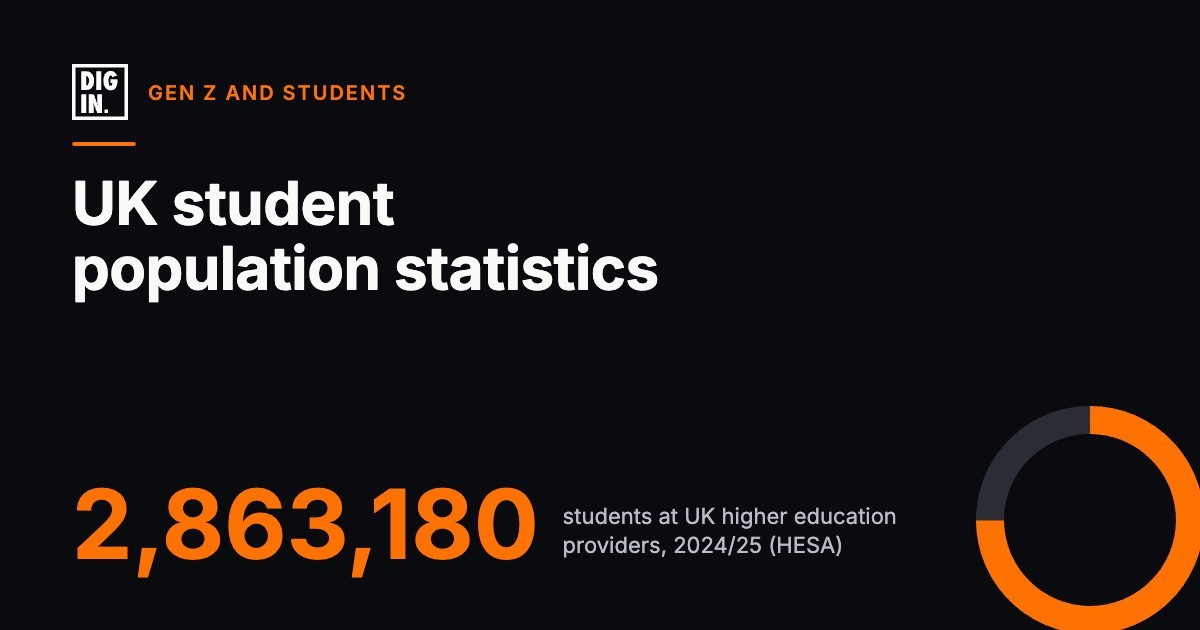
UK Student Population Statistics: How Many University Students Are There in the UK?
The latest HESA and UCAS figures on the UK student population: total enrolments, first-year intake, entry rates and the rise in students living at home.
8 min read