Gen Z and students
5 min read
Understanding Gen Z Values: Key Drivers of Student Purchases
Which values actually shape what Gen Z students buy, why stated values and real purchases differ, and how brands can show and test their values.
Gen Z students care about honesty, health, fairness, money and the environment, and they notice quickly when a brand overclaims. In everyday purchases those values sit alongside price, taste and convenience. The brands that win are the ones whose values are visible in the product itself, in its ingredients, packaging, price and range, rather than in messaging alone.
This guide covers the values that shape student purchases, the gap between what students say and what they buy, and how to show and test your brand’s values with this audience.
Key points
Values shape choice most when they are visible in the product: what is in it, what it comes in, what it costs and who it is for.
Students are quick to spot overclaiming. Specific, checkable claims carry more weight than broad promises.
Health is a practical value: in Coca-Cola’s 2026 student surveys, 51.0% preferred zero or reduced sugar (n=3,393).
Financial security is a value too: 88% of students in the Student Futures Index 2026 by Dig In with We Are Futures (n=1,086) called managing money their important life skill.
Test values claims with students before building a campaign on them.
The values that shape student purchases
Honesty and transparency
Students are used to scrolling past adverts and are sceptical of big claims. They respond to brands that say plainly what a product is, what is in it and what it costs. A specific claim, such as the recycled content of a bottle or the protein in a bar, is easier to believe than a general promise to “do better”.
Health and wellbeing
For many students, health is a day-to-day choice rather than an abstract cause. Sugar, protein, caffeine and ingredients all feature in decisions. In Coca-Cola’s 2026 student surveys, 51.0% of respondents said they preferred zero or reduced sugar options (n=3,393), which shows how much a health-related product choice can matter. See the Coca-Cola 2026 results.
Money and security
Being careful with money is a value in its own right for this generation. In the Student Futures Index 2026, 88% of students said managing money is an important life skill (Dig In with We Are Futures, n=1,086). Brands that respect a tight budget, through fair pricing, sensible pack sizes and no hidden catches, earn credit. Our guide to Gen Z spending habits covers this in more detail.
Inclusion and representation
Students expect to see people like them in a brand’s imagery and to find products that work for them, whether that means shade ranges, dietary options or sizing. Representation that is reflected in the product range is more convincing than representation that appears only in an advert.
Sustainability
Students living in halls see packaging waste piling up in shared kitchens and bins. Recyclable packaging, less plastic and useful, reusable items are noticed. Vague green claims are risky: the CMA’s Green Claims Code sets out what UK regulators expect, and students are quick to call out claims that do not stand up.
The gap between what students say and what they buy
Researchers have long described an attitude-behaviour gap: people say they will choose the ethical or sustainable option more often than they actually do at the till. Students are no exception. On a fixed budget, price and familiarity decide most everyday purchases, and values tip the balance when options are close.
This matters for planning. A survey that asks “do you care about sustainability?” will produce a high number. A better question asks students to choose between options with different prices and attributes, or measures what they do after trying a product.
How to show values, not just state them
Put it in the product. Ingredients, recipe, materials and range carry more weight than a campaign line.
Put it on the pack. One clear, checkable claim where students will see it, ideally with a way to find out more.
Show up usefully on campus. A product students actually use says more about a brand than a stunt that creates waste.
Be consistent. If a brand claims a value in September and contradicts it in January, students notice.
Choose partners carefully. Working with a student society on a cause it already cares about is more credible than borrowing a cause for one campaign.
How to test which values matter for your brand
Do not assume which values matter in your category. Ask. Dig In has collected over a million student survey responses since 2016, and the most useful values questions are practical ones:
Which of these would make you choose this product over another at the same price?
Would you pay more for it, and how much more?
What would make you stop buying it?
After trying it, how likely are you to buy it again?
Compare stated preferences with behaviour after trial. Our pages on research and how we measure explain how Dig In runs and reports student surveys.
Mistakes to avoid
Borrowing a cause. Attaching a brand to an issue it has no link to looks opportunistic.
Vague green claims. “Eco-friendly” without specifics invites scepticism and regulatory risk.
Ignoring price. A values story does not justify a price students cannot afford.
Talking down. Students can tell when a brand is lecturing them.
Questions brands ask
What do Gen Z students value most in brands?
Honesty, value for money, health and fairness come up consistently, along with sustainability. The values that matter most vary by category, so test them with your own audience.
Do Gen Z students really pay more for sustainable products?
Some do, but stated willingness to pay is usually higher than real behaviour, especially on a student budget. Sustainability is most effective as a reason to choose between products at a similar price.
How can a brand show its values to students without looking fake?
Make the value visible in the product and pack, keep claims specific and checkable, and act consistently across the year. Students respond to what a brand does more than to what it says.
Working with Dig In
Dig In puts brands into the hands of 500,000 students each September and asks them what they think, so you can test which values matter for your product. Get in touch to plan a campaign and survey together.
Read next

Gen Z and students
The Student Effect: Household Influence, Word of Mouth and Physical Marketing in the Age of AI
How returning students shape what their families buy and what their friends try, and an honest look at whether physical marketing such as sampling still earns its place as AI changes advertising.
9 min read

Gen Z and students
Student Cost of Living in the UK: What Students Spend, What They Get and What It Means for Brands
What UK students spend each month, including food, against what the Maintenance Loan covers, and how the gap shapes what students buy and try.
8 min read
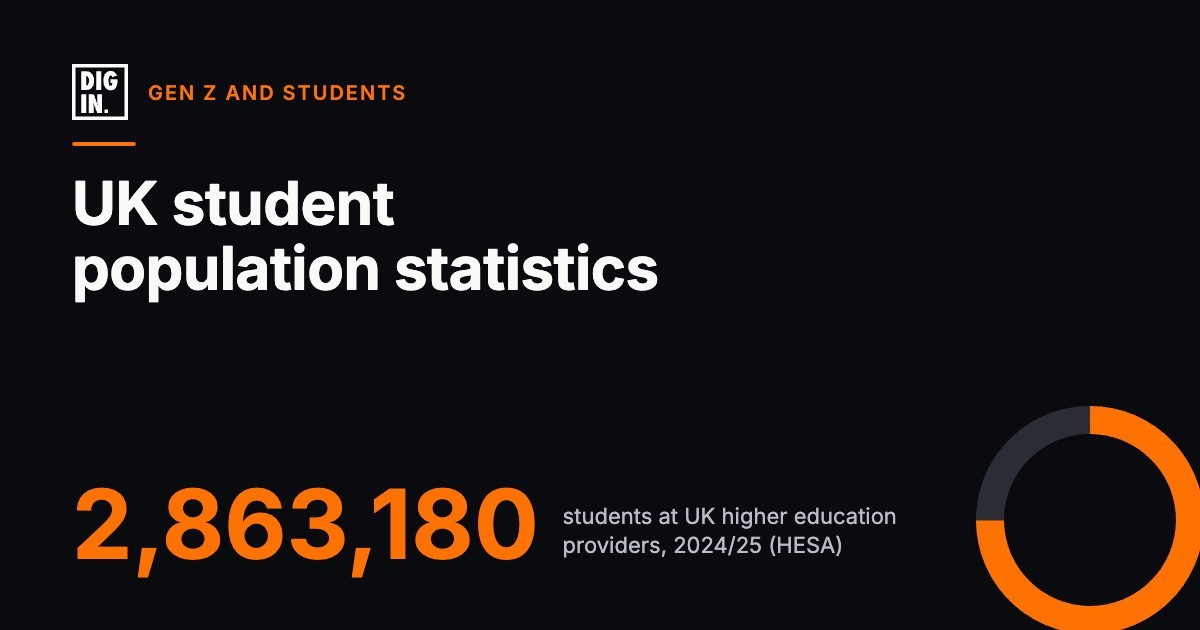
Gen Z and students
UK Student Population Statistics: How Many University Students Are There in the UK?
The latest HESA and UCAS figures on the UK student population: total enrolments, first-year intake, entry rates and the rise in students living at home.
8 min read