Gen Z and students
5 min read
Gen Z Student Behaviour Trends UK: What Brands Need to Know in 2026
The Gen Z student behaviour trends UK brands need to know in 2026: money pressure, value, trust in peers, in-person discovery and how values fit in.
UK Gen Z students in 2026 are spending carefully, judging brands on real value, trusting friends and flatmates more than polished advertising, and still discovering a lot in person. The brands that win with them lead with something useful, behave consistently and show up in the places and moments that fit student life.
Key points
Money pressure shapes everything: only 30% feel confident managing money (Student Futures Index 2026, Dig In with We Are Futures, 1,086 students).
Value beats vague “student-friendly” claims. Free trial and meaningful discounts change behaviour; token gestures don’t.
Trust is earned through consistency and peers, not polish.
Physical discovery still matters alongside TikTok and Instagram.
Values count, but alongside price and quality rather than instead of them.
The economic backdrop
Any conversation about student behaviour in 2026 starts with money. ONS labour market figures show unemployment among 16 to 24-year-olds has risen, and part-time work, a traditional lifeline for students, is harder to find. Save the Student’s National Student Money Survey shows the Maintenance Loan falling short of living costs for many students, with the gap filled by parents, part-time jobs, overdrafts or going without. Deloitte’s annual Gen Z and Millennial Survey has repeatedly found financial insecurity among Gen Z respondents.
Dig In’s own research points the same way. The Student Futures Index 2026, from Dig In with We Are Futures (1,086 students), found that 88% say managing money is an important life skill and only 30% feel confident managing money. See more of Dig In’s student research.
For brands, this is the context every campaign lands in. A student looking at a product is running a constant calculation about whether it is worth the money, and whether the brand understands what their week-to-week budget looks like.
Trend 1: Value is the entry price
Students are still spending, but more deliberately. They expect a tangible reward for choosing a brand, and they can tell a real saving from a token one. A vague "student-friendly" claim with nothing behind it is easy to dismiss.
Free trial is the clearest form of value, because it removes the risk entirely. When students try a product they like, they say so: the median brand in Dig In’s surveys saw 85% of students say they were likely to buy again after trying the product (2025, 24 surveys), rising to 88% in 2026. That is stated intent, not sales, but it shows how well trial lands with a cautious audience.
Preferences are shifting within categories too. Coca-Cola’s 2026 student surveys found 51.0% prefer zero or reduced sugar (n=3,393), and 89.9% said they were likely to buy Original and Zero (n=3,019). See the Coca-Cola case study.
Trend 2: Trust comes from consistency and peers
Gen Z responds more to direct, personal communication than to broadcast advertising. Smaller creators who feel like real people tend to move purchase intent more than glossy celebrity campaigns, and a genuine reply on social media or a useful email lands better than scale for its own sake.
Students also spot forced partnerships quickly, and they say so within their own circles. A sponsored post that doesn’t ring true does more damage than no post.
Trust for this generation is less about being funny or cool and more about consistency between what a brand says and what it does: a sustainability claim, a diversity commitment, or simply how a complaint gets handled. Peers carry the most weight of all. A recommendation from a flatmate beats an advert, which is why peer influence belongs in any student plan.
Trend 3: Experience and in-person discovery still matter
Being digital natives hasn’t stopped students discovering things in person. Shops, campus spaces and halls remain places where students find new products, and many prefer to try things before buying.
The strongest student brands build around moments that fit student life: the first week of term, a night out, exam season. Physical moments at the right time get noticed. When students arrive at university, 88.7% said the Welcome Bag improved their welcome, rating it 4.3 out of 5 (2024, n=48,991). Useful items stay in use: 96% of students were still carrying the Santander tote weeks later (n=50,000, Santander’s End of Campaign Report 2025).
Trend 4: Media habits have matured
Social platforms remain central to how students discover brands. Short-form video drives most organic discovery, and many students treat TikTok as a search engine as well as an entertainment feed.
Digital-only plans still miss a lot. Students read physical materials on campus, value in-person contact with brand reps at key moments, and use email for things that matter to them: more than 64,000 students signed up to mydigin.com during Freshers 2026 (Customer.io, 8 October 2026). The practical answer is a plan that joins online discovery to something tangible in the real world.
Trend 5: Values matter, within limits
Affordability hasn’t replaced values-driven spending. Many Gen Z consumers weigh a brand’s environmental and ethical record, and some stop buying from companies whose behaviour doesn’t match their messaging. The shift is that students now apply values as one filter among several, alongside price, quality and convenience.
A sustainability claim without fair value or real product quality behind it won’t carry a student on a tight budget to the checkout. Fair value and demonstrable ethics together make a far stronger case than either alone.
What this means for brands in 2026
Lead with real value. A free trial or a meaningful, easy-to-claim discount does more than affordability messaging.
Behave consistently. Students judge brands on whether actions match words.
Earn peer recommendation. Give students something worth sharing with flatmates and friends.
Show up in person at the right moments. Arrival, Refreshers in January and exam season are when physical touchpoints get noticed.
Join physical and digital. Use QR codes, sign-ups and follow-up so a first experience leads somewhere.
Questions brands ask
What are the biggest Gen Z student trends UK brands should track in 2026?
Tight budgets, a preference for real value over vague affordability claims, trust in peers and consistent brands over polished advertising, and continued in-person discovery alongside social media. The Student Futures Index 2026 (Dig In with We Are Futures, 1,086 students) found only 30% feel confident managing money.
Why does affordability matter so much to UK students now?
Living costs often outstrip the Maintenance Loan, according to Save the Student’s National Student Money Survey, and part-time work is harder to find as youth unemployment has risen. That makes every purchase more deliberate.
Do UK Gen Z students still respond to physical marketing?
Yes, when it is useful and well timed. 88.7% of students said the Welcome Bag improved their welcome (2024, n=48,991), and 96% were still carrying the Santander tote weeks later (n=50,000, Santander’s End of Campaign Report 2025).
Working with Dig In
Dig In has reached students arriving at university since 2015 and runs its own student surveys, with over a million responses since 2016. If you want to understand what this generation thinks about your category, talk to our team.
Read next

Gen Z and students
The Student Effect: Household Influence, Word of Mouth and Physical Marketing in the Age of AI
How returning students shape what their families buy and what their friends try, and an honest look at whether physical marketing such as sampling still earns its place as AI changes advertising.
9 min read

Gen Z and students
Student Cost of Living in the UK: What Students Spend, What They Get and What It Means for Brands
What UK students spend each month, including food, against what the Maintenance Loan covers, and how the gap shapes what students buy and try.
8 min read
Gen Z and students
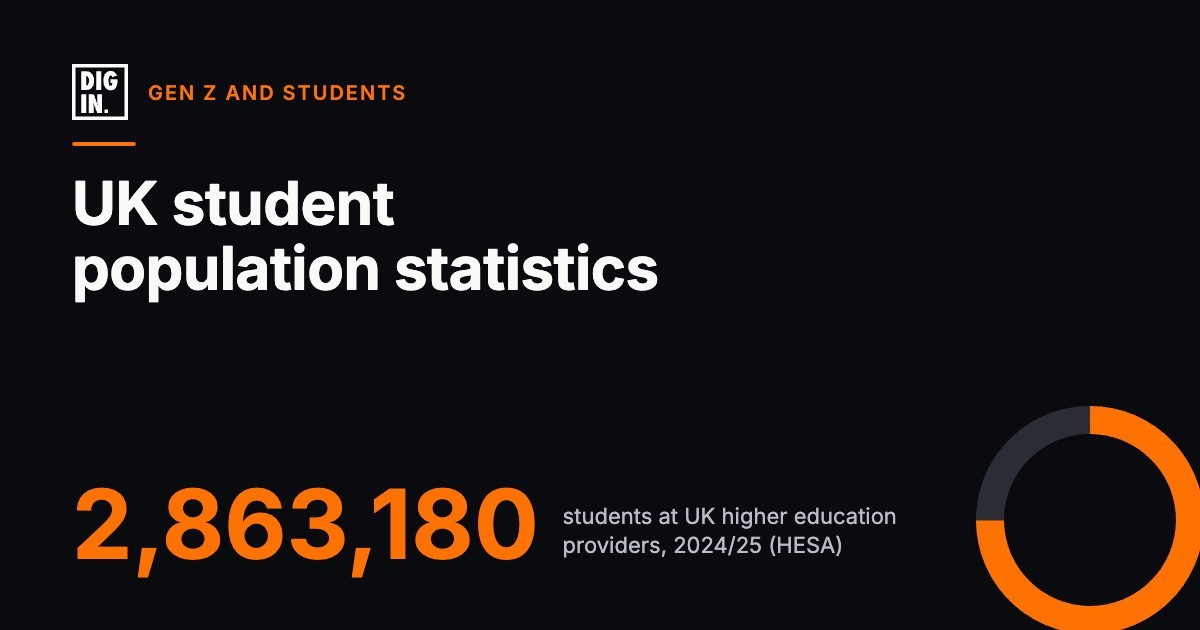
UK Student Population Statistics: How Many University Students Are There in the UK?
The latest HESA and UCAS figures on the UK student population: total enrolments, first-year intake, entry rates and the rise in students living at home.
8 min read