Gen Z and students
6 min read
What Gen Z Students Want From Brands
Gen Z students want brands that are honest, useful and fair on price. What that means for marketers, with trial data from Dig In’s student surveys.
Gen Z students want brands that are honest, useful and fair on price. They check claims quickly, trust friends more than adverts, and judge a brand by how the product performs rather than what the campaign says. For brands, that makes a good first trial the most persuasive message available.
Key points
Students judge brands on what they do. A gap between a brand’s claims and its behaviour gets noticed and shared.
Money is tight, so a product has to earn its place in the weekly shop: only 30% of students feel confident managing money (Student Futures Index 2026, Dig In with We Are Futures, 1,086 students).
Recommendations from flatmates and friends carry more weight than celebrity endorsement or paid social.
Students discover products online but still decide in person, so physical experience of a product matters.
Trial meets all of these needs at once. Across Dig In’s benchmark, the median brand scored 85% likely to buy again after sampling (2025, 24 surveys).
Honesty they can check
Students born roughly between 1997 and 2012 grew up fact-checking in real time. McKinsey’s “True Gen” research described this generation’s defining trait as a search for truth, both about themselves and about the companies they buy from. In practice, a student can find out how a brand treats its staff, its suppliers and its customers within a minute, and the comment section will tell them if anyone has caught it out.
The result is a low tolerance for staged messaging. A values statement means little if the brand’s own behaviour tells a different story, and students tend to notice the gap before the marketing team does. What earns trust is consistency: the same promise on the pack, in the advert and in the customer service inbox.
Humour and trend-chasing only go so far. A witty post can get a brand noticed, but students stay with brands that understand their everyday problems: a tight budget, a shared kitchen, a first year away from home.
Value for money, with values attached
Price matters to students more than to almost any other group. In the Student Futures Index 2026, produced by Dig In with We Are Futures from a survey of 1,086 students, only 30% said they feel confident managing money and 88% said managing money is an important life skill. Deloitte’s annual Gen Z and Millennial Survey has also put the cost of living at the top of this generation’s concerns.
That does not make students indifferent to values. Many will still choose a brand they see as responsible, provided the product is good and the price is fair. The calculation is about which brand deserves a limited budget, and environmental claims, ingredients and the way a company behaves all feed into it. What they will not do is pay extra for a promise they cannot see in the product.
Recommendations from people they know
Students trust each other more than they trust brands. A flatmate who swears by a snack, a deodorant or a banking app is more persuasive than any celebrity, because the recommendation costs them nothing and they have used the product. Small creators who feel like peers tend to land better than big names for the same reason.
University concentrates this effect. First-year students live in shared flats, cook in shared kitchens and talk in group chats from day one. When a product arrives in every room of a hall at the same time, the conversation starts by itself. We cover this in more depth in the role of peer influence in university marketing.
Online for discovery, in person for decisions
Gen Z is often described as a purely digital generation. Students do find products on TikTok and Instagram, but the decision to buy is shaped by much more: a friend’s view, a look in the shop, a review, and above all whether they have tried it.
Physical experience still counts, especially at the start of university. In Dig In’s 2024 Golden Ticket survey, 88.7% of students said the Welcome Bag improved their welcome to university, rating it 4.3 out of 5 (n=48,991). A product that arrives in a student’s room, from a source they welcome, starts with goodwill that a feed advert does not have.
Proof over promises: what trial tells us
If students want brands to prove themselves, the most direct proof is letting them use the product. Dig In has run 196 brand surveys for 161 brands since 2018, asking students what they thought after trying a product. The median brand scored 85% likely to buy again (2025, 24 surveys), and 96% would recommend (2025, 20 surveys). The full picture is in the Dig In Trial Benchmark.
Surveys also tell brands what students want before they ask for it. In Coca-Cola’s 2026 programme with Dig In, 89.9% of students said they were likely to buy Coca-Cola Original and Zero after trying them (n=3,019), and 51.0% said they prefer zero or reduced-sugar drinks (n=3,393). The second figure is the kind of insight a brand can act on. The Coca-Cola 2026 case study has the detail.
These are purchase-intent figures, not sales. They show what students say they will do after a real trial, which is a better guide than how many people saw an advert.
What this means for brands
Lead with the product. Let students try it before you ask them to believe anything about it.
Be specific. Concrete claims with dates and evidence outperform broad promises.
Price for a student budget. A meaningful student offer at the point of first purchase does more than a token discount.
Make it easy to share. Give students a reason to tell their flatmates, not a script to repeat.
Ask them. A short survey after trial tells you what worked and gives you numbers to take to your buyers.
The cost of getting it wrong
Students walk away from brands that let them down, and they tell people when they do. A sustainability claim that does not hold up, or a cause campaign that feels opportunistic, can travel through a university as quickly as a good recommendation. Trust lost at 19 is hard to win back at 25.
The brands that do well with this generation are rarely the loudest. They are clear about who they are, consistent in how they behave, and confident enough in the product to put it in students’ hands.
Questions brands ask
What do Gen Z students care about most when choosing a brand?
Value for money, honesty and whether the product works. Students are on tight budgets, check brand claims quickly and rely heavily on recommendations from friends.
Do Gen Z students respond to traditional advertising?
Less than older groups do. They notice paid social and adverts, but they trust their own experience and their peers more, so advertising works best alongside a way to try the product.
How can a brand prove itself to students quickly?
Give them the product at a moment that matters, such as arrival at university, and ask what they thought. Across Dig In’s benchmark, the median brand scored 85% likely to buy again after sampling (2025, 24 surveys).
Working with Dig In
Dig In puts brands into the hands of 500,000 students each September through the Welcome Bag, Live Activations and mydigin.com, and measures the response with student surveys. To see how your product would land with students, read about product sampling with Dig In or get in touch.
Read next

Gen Z and students
The Student Effect: Household Influence, Word of Mouth and Physical Marketing in the Age of AI
How returning students shape what their families buy and what their friends try, and an honest look at whether physical marketing such as sampling still earns its place as AI changes advertising.
9 min read

Gen Z and students
Student Cost of Living in the UK: What Students Spend, What They Get and What It Means for Brands
What UK students spend each month, including food, against what the Maintenance Loan covers, and how the gap shapes what students buy and try.
8 min read
Gen Z and students
UK Student Population Statistics: How Many University Students Are There in the UK?
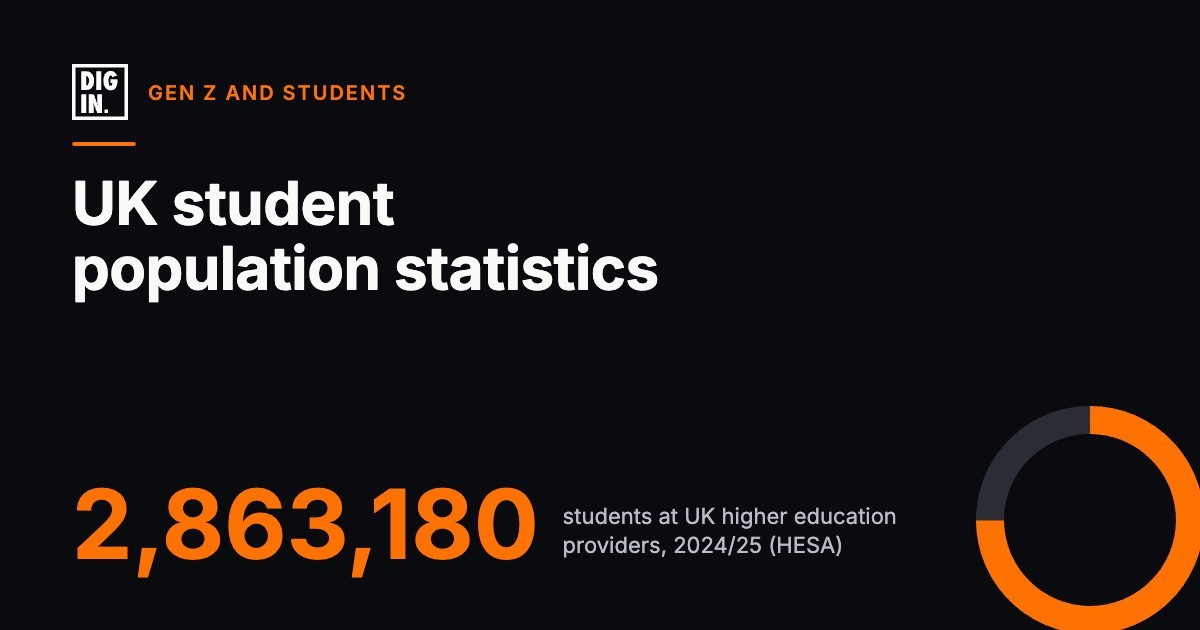
The latest HESA and UCAS figures on the UK student population: total enrolments, first-year intake, entry rates and the rise in students living at home.
8 min read